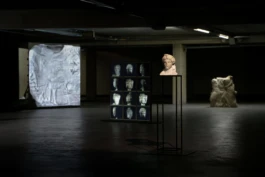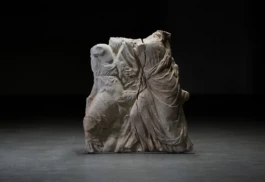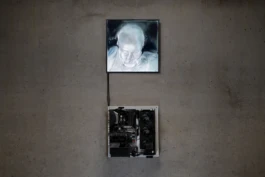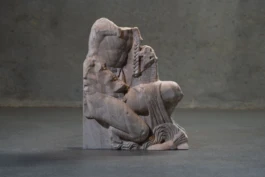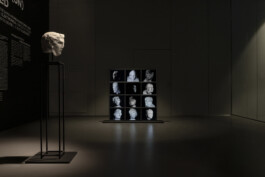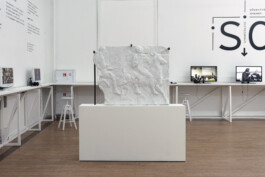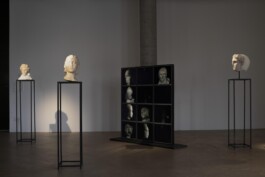
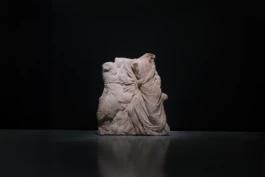
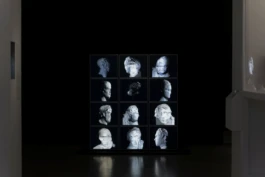
Initiated in 2017, ongoing.
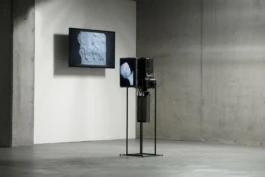
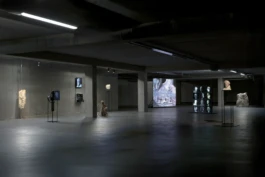
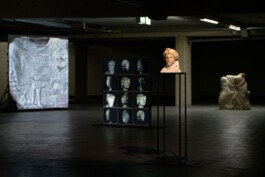
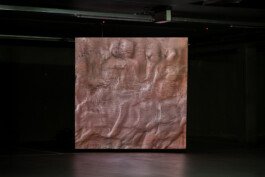
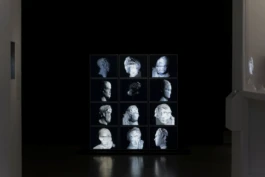
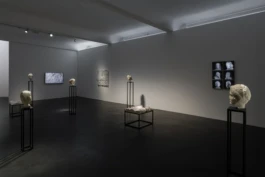
Marble, polyamide, machine learning algorithms, custom software, original dataset, multichannel video installation.
Machine learning research collaborator: Artem Konevskikh.
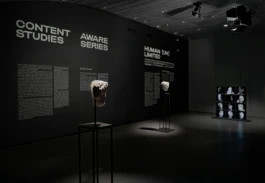
Content Aware Studies (CAS) series is comprised of a vast amount of data, AI experiments, objects, moving image works, films and essays. It inquires how the use of machine learning in historical analysis and reproduction as a scientific tool brings to the forefront ethical questions of bias contamination within data and automation of its analysis. Inspired by examples of confusing para-scientific interventions such as AI-based Voynich Manuscript decryptions, the CAS series examines the various sides of this inquiry. It also speculates about material objects as synthetic documents of machine-rendered histories.
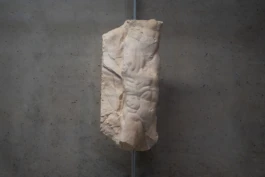
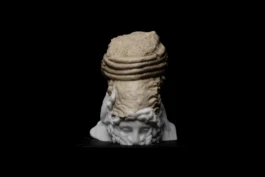
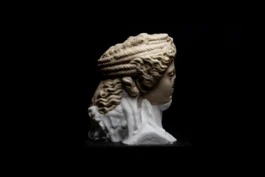
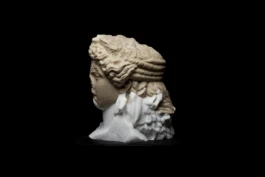
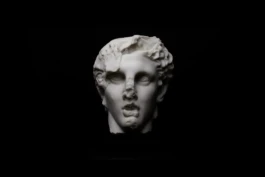
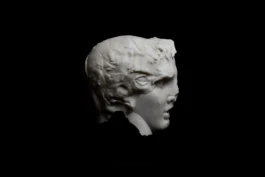
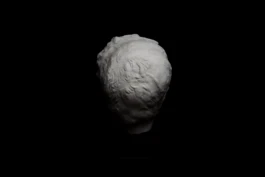
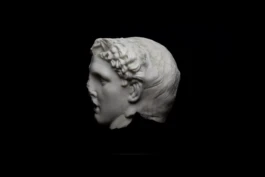
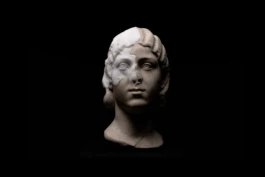
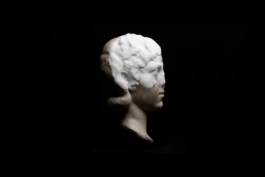
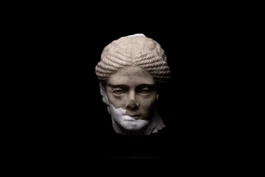
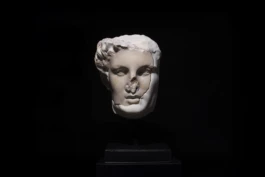
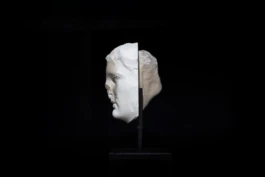
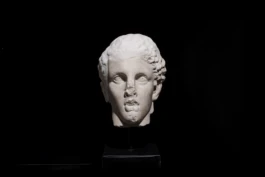
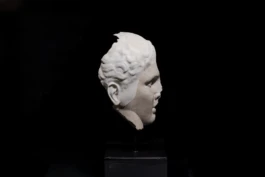
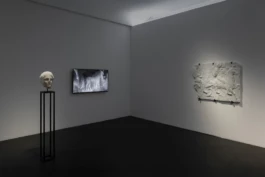
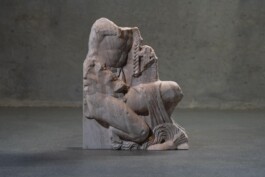
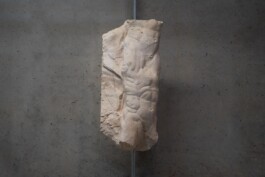
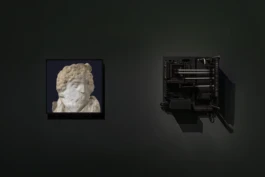
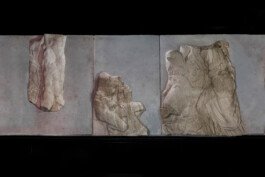
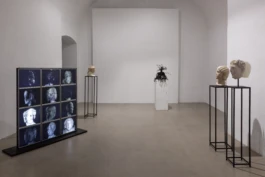
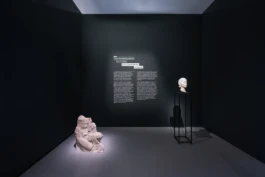
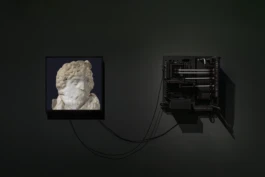
The objects from the initial iteration of the CAS series came through methodologies developed with data scientists and based on training artificial neural networks aiming to replenish lost fragments of sculptures, friezes and other objects of classical antiquity as well as to generate never-before-existing, yet algorithmically genuine, objects of that era. The research examined outputs of advanced AI models trained on datasets consisting of thousands of 3D scans of classical sculptures from renowned international museum collections. The models generated by the algorithm were then 3D-printed in various synthetic materials, filling the voids in eroded and damaged marble sculptures. Some of these algorithmic outputs were turned into entirely new marble sculptures carved by machines. Uncanny in their algorithmic integrity, they posed questions about whether they can be considered objects of classical antiquity. They render the work of a synthetic agency that lends faithful authenticity to the forms, while also producing bizarre errors and algorithmic normalizations of forms previously standardized and regulated by the canon of Hellenistic and Roman art.
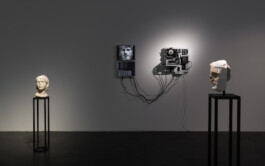


Materiality has reappeared as a highly contested topic in recent art. Modernist criticism tended to privilege form over matter — considering the material as the essentialized basis of medium specificity - and technically based approaches in art history reinforced connoisseurship through the science of artistic materials. But in order to engage critically with materiality in the post-digital era, the time of big data and automation, we may need a very different set of methodological tools.
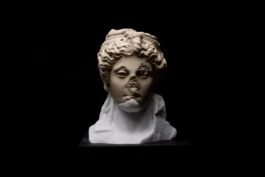
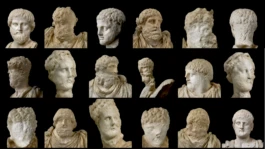
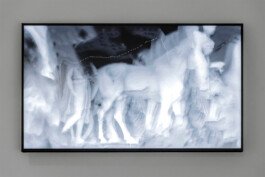
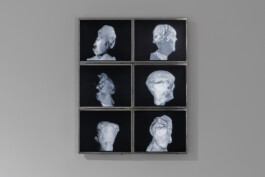
We may need to address digital infrastructures as entirely physical and to re-examine the notion of “dematerialization”, by addressing materialist critiques of artistic production, surveying relationships between matter and bodies, exploring the vitality of substances; and looking closely at the concepts of inter-materiality and trans-materiality emerging in the hybrid zones of digital experimentation. The image below is a result of the interpretation of an antique portrait by a general adversarial neural network based on the analysis of nearly 10,000 3D scans. The custom-created dataset included 3d scans of sculptures from the collections of the Metropolitan Museum, Hermitage, British Museum, National Museum of Rome and other world-renowned collections of antiquity.

The film intends to open up speculations and thought experiments into history, matter, agency and computation. History in this context is seen as data; while data is seen as a crude material and critical resource for content-form-knowledge production through which production and investigation? questions of origin and genuine-ness are posed and aesthetic implications can be studied. How are historical narratives, documents, and their meaning and function perverted when they collide with ubiquitous machine vision and translation? In other words what happen to historical knowledge in the age of the information epidemic aforementioned and computational reality engineering? These questions are asked about synthetic forms of knowledge production as a result of outputs of machine-learning (ML)-technologies operating on historical archives. They inquire about the capacities and consequences of such machine-learning technologies as a means of automated historical investigation and question whether these findings still hold historical qualities.
One of the main questions about technology and culture, posed here is: what are the ethical, philosophical, and historical challenges we’re facing when using such automated means of production and investigation? Can applications of such technology allows us to uncover deeper and sharply unsuspected new knowledge or do they mask unacknowledged biases?
As part of this investigation, we look into the project Content Aware Studies (CAS), which through artistic practice seeks to establish investigative methods of these machine-learning-capacities. This research examines how various advanced AI, or more specifically General Adversarial - Networks (GANs), which are particularly known for their recent advancements in computer vision, cognition, and hyper-realistic image rendering operate when trained on datasets consisting of thousands of 3D scans from renowned international museum collections. Specifically trained neural network models are directed to replenish lost fragments of friezes and sculptures and thus generate previously never existing objects of classical antiquity. The algorithm generates results convertible into 3D models, which are then 3D-printed in synthetic materials and used to fill the voids of the original sculptures, or turned into entirely new machine-fabricated marble objects; Faithfully restoring original forms, while also producing bizarre errors and algorithmic interpretations of previously familiar to us Hellenistic and Roman art, which are then embodied in machine carved stone blocks. Uncanny in their algorithmic integrity they render the work of a synthetic agency that lends a faithful authenticity to the forms, while also producing bizarre errors and algorithmic normalisation of forms previously standardised and regulated by the canon of Hellenistic art.
A series of essays on Synthetic Histories, Hylomorphism and Materiality, and Predispositions by Design in which the work Content Aware Studies is at the centre as a case study for the proposed critique of AI-driven methodology in historiography.
Links to downloadable PDFs:
2022 ‘Museum of Synthetic Histories’ - E. Kraft, E. Kormilitsyna | Published by BCS. Learning and Development Ltd. Proceedings of POM Conference, UDK Berlin 2021
2021 ‘On Content Aware and Other Case-Studies’ - E. Kraft, E. Kormilitsyna | Published by City University of Hong Kong, HKG

‘Museum of Synthetic Histories’ Essay Book Cover.
Initiated in 2017, ongoing.
Marble, polyamide, machine learning algorithms, custom software, original dataset, multichannel video installation.
Machine learning research collaborator: Artem Konevskikh.
The series includes sculptures, videos and texts as inquiries into reverse-archeology via Ai models and datasets of 3d scans. Aimed at reconstructing missing fragments within the sculptures of classical antiquities and paleontological objects these computational systems are exercised at speculative object-oriented historicism of never-existed, yet algorithmically genuine, documents of synthetic histories.
Content Aware Studies series inquires into the aesthetic, philosophical, and historiographical outcomes of computational and particularly in relation to modern generative AI models, reconstruction and generative reinterpretation of the objects of art of classical antiquity and in particular to fill the voids of the missing fragments. The automated algorithmic training is performed on the manually assembled dataset over thousands of 3D scans of friezes and sculptures of the era. The series concerns the prospects of methods involving data, ML, AI, and other computational automations turning into semi- and quasi-archeological knowledge productions when performed to augment historical and cultural studies in the era of ubiquitous planetary-scale computation. Some of these algorithmic outputs are then turned into new machine-fabricated sculptures uncanny in their algorithmic integrity. They render the work of synthetic agency that lends faithful authenticity to the forms, while also producing eerie errors and algorithmically bizarre normalisations of forms previously standardised and regulated by the canon of Hellenistic and Roman art. These speculative forms of restoration, museology, and historiography provide a case study for critical examination of possibly misleading trajectories of algorithmically augmented research and knowledge production, poisoned by epistemic focal biases occurring at the level of software architecture of radical complexity. Preoccupied with biases, misleading guises, quasi-authenticities, and mixed-up entanglements of material and informational domains, it seeks to examine epistemological issues. The series questions: what epistemics do such methodologies hold by uncovering deeper and sharply unsuspected new knowledge or instead masking unacknowledged biases? In the optics of a non-human agency of the AI-investigator, what of our historical knowledge and interpretation encoded into the datasets will survive this digital digestion? How are historical narratives, documents, their meaning, and function perverted when their analysis has been outsourced to machine vision and cognition? What changes can we anticipate in historical knowledge and documentation during the era of the information overproduction epidemic and generative reality modeling?
The film intends to open up speculations and thought experiments into history, matter, agency and computation. History in this context is seen as data; while data is seen as a crude material and critical resource for content-form-knowledge production through which production and investigation? questions of origin and genuine-ness are posed and aesthetic implications can be studied. How are historical narratives, documents, and their meaning and function perverted when they collide with ubiquitous machine vision and translation? In other words what happen to historical knowledge in the age of the information epidemic aforementioned and computational reality engineering? These questions are asked about synthetic forms of knowledge production as a result of outputs of machine-learning (ML)-technologies operating on historical archives. They inquire about the capacities and consequences of such machine-learning technologies as a means of automated historical investigation and question whether these findings still hold historical qualities.
One of the main questions about technology and culture, posed here is: what are the ethical, philosophical, and historical challenges we’re facing when using such automated means of production and investigation? Can applications of such technology allows us to uncover deeper and sharply unsuspected new knowledge or do they mask unacknowledged biases?
As part of this investigation, we look into the project Content Aware Studies (CAS), which through artistic practice seeks to establish investigative methods of these machine-learning-capacities. This research examines how various advanced AI, or more specifically General Adversarial - Networks (GANs), which are particularly known for their recent advancements in computer vision, cognition, and hyper-realistic image rendering operate when trained on datasets consisting of thousands of 3D scans from renowned international museum collections. Specifically trained neural network models are directed to replenish lost fragments of friezes and sculptures and thus generate previously never existing objects of classical antiquity. The algorithm generates results convertible into 3D models, which are then 3D-printed in synthetic materials and used to fill the voids of the original sculptures, or turned into entirely new machine-fabricated marble objects; Faithfully restoring original forms, while also producing bizarre errors and algorithmic interpretations of previously familiar to us Hellenistic and Roman art, which are then embodied in machine carved stone blocks. Uncanny in their algorithmic integrity they render the work of a synthetic agency that lends a faithful authenticity to the forms, while also producing bizarre errors and algorithmic normalisation of forms previously standardised and regulated by the canon of Hellenistic art.
Materiality has reappeared as a highly contested topic in recent art. Modernist criticism tended to privilege form over matter — considering the material as the essentialized basis of medium specificity - and technically based approaches in art history reinforced connoisseurship through the science of artistic materials. But in order to engage critically with materiality in the post-digital era, the time of big data and automation, we may need a very different set of methodological tools.
We may need to address digital infrastructures as entirely physical and to re-examine the notion of “dematerialization”, by addressing materialist critiques of artistic production, surveying relationships between matter and bodies, exploring the vitality of substances; and looking closely at the concepts of inter-materiality and trans-materiality emerging in the hybrid zones of digital experimentation. The image below is a result of the interpretation of an antique portrait by a general adversarial neural network based on the analysis of nearly 10,000 3D scans. The custom-created dataset included 3d scans of sculptures from the collections of the Metropolitan Museum, Hermitage, British Museum, National Museum of Rome and other world-renowned collections of antiquity.

A series of essays on Synthetic Histories, Hylomorphism and Materiality, and Predispositions by Design in which the work Content Aware Studies is at the centre as a case study for the proposed critique of AI-driven methodology in historiography.
Links to downloadable PDFs:
2022 ‘Museum of Synthetic Histories’ - E. Kraft, E. Kormilitsyna | Published by BCS. Learning and Development Ltd. Proceedings of POM Conference, UDK Berlin 2021
2021 ‘On Content Aware and Other Case-Studies’ - E. Kraft, E. Kormilitsyna | Published by City University of Hong Kong, HKG

‘Museum of Synthetic Histories’ Essay Book Cover.
Tokyo, Mishuku, JPN
Vienna, Neubau, AUT
Egor G. Kraft – artist-researcher, founder
Anna Kraft – researcher, director
mail[at]kraft.studio
Tokyo, Mishuku, JPN
Vienna, Neubau, AUT
mail[at]kraft.studio
Egor G. Kraft – artist-researcher, founder
Anna Kraft – researcher, director
Content Aware Studies, 2017-2025
The New Color, 2011-2018
1 & ∞ ⑁ One & Infinite Chairs, 2023
Hashd0x. Proof of War, 2022
Decentralised Embargo, 2022
Ais Kiss, 2017
Chinese Ink, 2018
PropaGAN, 2022
URL Stone, 2015
The Link, 2015
Twelve Nodes, 2019
Scatterchive
I Print, Therefore I Am, 2014
Kickback, 2014
Unfolding, 2011
The Moment, The Past, 2014


Site Index